Recombinant Human Pleckstrin homology domain-containing family A member 1 (PLEKHA1)
-
中文名稱:人PLEKHA1重組蛋白
-
貨號:CSB-YP864016HU
-
規格:
-
來源:Yeast
-
其他:
-
中文名稱:人PLEKHA1重組蛋白
-
貨號:CSB-EP864016HU
-
規格:
-
來源:E.coli
-
其他:
-
中文名稱:人PLEKHA1重組蛋白
-
貨號:CSB-EP864016HU-B
-
規格:
-
來源:E.coli
-
共軛:Avi-tag Biotinylated
E. coli biotin ligase (BirA) is highly specific in covalently attaching biotin to the 15 amino acid AviTag peptide. This recombinant protein was biotinylated in vivo by AviTag-BirA technology, which method is BriA catalyzes amide linkage between the biotin and the specific lysine of the AviTag.
-
其他:
-
中文名稱:人PLEKHA1重組蛋白
-
貨號:CSB-BP864016HU
-
規格:
-
來源:Baculovirus
-
其他:
-
中文名稱:人PLEKHA1重組蛋白
-
貨號:CSB-MP864016HU
-
規格:
-
來源:Mammalian cell
-
其他:
產品詳情
-
純度:>85% (SDS-PAGE)
-
基因名:
-
Uniprot No.:
-
別名:OTTHUMP00000020651; PH domain containing family A member 1; PH domain-containing family A member 1; PKHA1_HUMAN; Pleckstrin homology domain containing A1; Pleckstrin homology domain containing family A member 1; Pleckstrin homology domain containing, family A (phosphoinositide binding specific) member; Pleckstrin homology domain-containing family A member 1; PLEKHA1; Tandem PH domain containing protein 1; Tandem PH domain-containing protein 1; TAPP 1; TAPP-1; TAPP1
-
種屬:Homo sapiens (Human)
-
蛋白長度:full length protein
-
表達區域:1-404
-
氨基酸序列MPYVDRQNRI CGFLDIEENE NSGKFLRRYF ILDTREDSFV WYMDNPQNLP SGSSRVGAIK LTYISKVSDA TKLRPKAEFC FVMNAGMRKY FLQANDQQDL VEWVNVLNKA IKITVPKQSD SQPNSDNLSR HGECGKKQVS YRTDIVGGVP IITPTQKEEV NECGESIDRN NLKRSQSHLP YFTPKPPQDS AVIKAGYCVK QGAVMKNWKR RYFQLDENTI GYFKSELEKE PLRVIPLKEV HKVQECKQSD IMMRDNLFEI VTTSRTFYVQ ADSPEEMHSW IKAVSGAIVA QRGPGRSASS EHPPGPSESK HAFRPTNAAT ATSHSTASRS NSLVSTFTME KRGFYESLAK VKPGNFKVQT VSPREPASKV TEQALLRPQS KNGPQEKDCD LVDLDDASLP VSDV
-
蛋白標簽:Tag?type?will?be?determined?during?the?manufacturing?process.
The tag type will be determined during production process. If you have specified tag type, please tell us and we will develop the specified tag preferentially. -
產品提供形式:Lyophilized powder
Note: We will preferentially ship the format that we have in stock, however, if you have any special requirement for the format, please remark your requirement when placing the order, we will prepare according to your demand. -
復溶:We recommend that this vial be briefly centrifuged prior to opening to bring the contents to the bottom. Please reconstitute protein in deionized sterile water to a concentration of 0.1-1.0 mg/mL.We recommend to add 5-50% of glycerol (final concentration) and aliquot for long-term storage at -20℃/-80℃. Our default final concentration of glycerol is 50%. Customers could use it as reference.
-
儲存條件:Store at -20°C/-80°C upon receipt, aliquoting is necessary for mutiple use. Avoid repeated freeze-thaw cycles.
-
保質期:The shelf life is related to many factors, storage state, buffer ingredients, storage temperature and the stability of the protein itself.
Generally, the shelf life of liquid form is 6 months at -20°C/-80°C. The shelf life of lyophilized form is 12 months at -20°C/-80°C. -
貨期:Delivery time may differ from different purchasing way or location, please kindly consult your local distributors for specific delivery time.Note: All of our proteins are default shipped with normal blue ice packs, if you request to ship with dry ice, please communicate with us in advance and extra fees will be charged.
-
注意事項:Repeated freezing and thawing is not recommended. Store working aliquots at 4°C for up to one week.
-
Datasheet :Please contact us to get it.
產品評價

相關產品
靶點詳情
-
功能:Binds specifically to phosphatidylinositol 3,4-diphosphate (PtdIns3,4P2), but not to other phosphoinositides. May recruit other proteins to the plasma membrane.
-
基因功能參考文獻:
- investigated the association of PLEKHA1 958A/G, polymorphisms with Age-Related Macular Degeneration (AMD) risk. PLEKHA1 958A/G polymorphism was associated with a decreased AMD risk (additive model: aOR=0.722, 95% CI=0.450-0.979, P=0.019; allele model: aOR=0.883, 95% CI=0.736-0.992, P=0.014) PMID: 29565837
- Studies indicate that the high-risk allele of the 10q26 locus encompasses three genes, PLEKHA1, ARMS2, and HTRA1 with high linkage disequilibrium. PMID: 26427389
- CX3CR1 (T280M and V249I) and PLEKHA1 (A320T) polymorphisms were not found to be associated with age-related macular degeneration in an Indian population. PMID: 25050486
- This study provides evidence of the joint contribution of genetic variants in PLEKHA1/ARMS2/HTRA1 to age-related macular degeneration risk. PMID: 24013816
- TAPP1 binds to protein tyrosine phosphatase PTPL1. PMID: 14516276
- syntrophins regulate the localization of TAPP1, which may be important for remodeling the actin cytoskeleton in response to growth factor stimulation PMID: 15485858
- PLEKHA1 is strongly implicated as primarily responsible for the evidence of linkage of age-related maculopathy (ARM) to the 10q26 locus and as a major contributor to ARM.susceptibility. PMID: 16080115
- Although a role for PLEKHA1 could not be totally excluded, there was a four times higher age-related macular degeneration risk was associated with haplotype "A-T-A" involving "PLEKHA1-LOC387715-HTRA1" risk alleles. PMID: 18079691
- Independent of CFH genotype or smoking history, an individual's risk of AMD (age-related macular degeneration) could be increased or decreased, depending on their genotype or haplotype in the 10q26 region. PMID: 18164066
顯示更多
收起更多
-
亞細胞定位:Cytoplasm. Cell membrane; Peripheral membrane protein. Nucleus.
-
組織特異性:Highly expressed in skeletal muscle, thymus, pancreas, placenta and lung. Detected at low levels in brain, heart, peripheral blood leukocytes, testis, ovary, spinal cord, thyroid, kidney, liver, small intestine and colon.
-
數據庫鏈接:
Most popular with customers
-
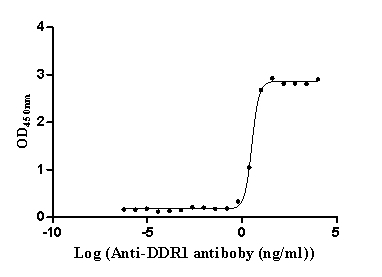
Recombinant Human Epithelial discoidin domain-containing receptor 1 (DDR1), partial (Active)
Express system: Mammalian cell
Species: Homo sapiens (Human)