Recombinant Mouse Phosphatidylinositol 4-phosphate 5-kinase type-1 beta (Pip5k1b)
-
中文名稱:小鼠Pip5k1b重組蛋白
-
貨號:CSB-YP018026MO
-
規格:
-
來源:Yeast
-
其他:
-
中文名稱:小鼠Pip5k1b重組蛋白
-
貨號:CSB-EP018026MO
-
規格:
-
來源:E.coli
-
其他:
-
中文名稱:小鼠Pip5k1b重組蛋白
-
貨號:CSB-EP018026MO-B
-
規格:
-
來源:E.coli
-
共軛:Avi-tag Biotinylated
E. coli biotin ligase (BirA) is highly specific in covalently attaching biotin to the 15 amino acid AviTag peptide. This recombinant protein was biotinylated in vivo by AviTag-BirA technology, which method is BriA catalyzes amide linkage between the biotin and the specific lysine of the AviTag.
-
其他:
-
中文名稱:小鼠Pip5k1b重組蛋白
-
貨號:CSB-BP018026MO
-
規格:
-
來源:Baculovirus
-
其他:
-
中文名稱:小鼠Pip5k1b重組蛋白
-
貨號:CSB-MP018026MO
-
規格:
-
來源:Mammalian cell
-
其他:
產品詳情
-
純度:>85% (SDS-PAGE)
-
基因名:
-
Uniprot No.:
-
別名:Pip5k1b; Pip5k1a; Phosphatidylinositol 4-phosphate 5-kinase type-1 beta; PIP5K1-beta; PtdIns(4)P-5-kinase 1 beta; EC 2.7.1.68; Phosphatidylinositol 4-phosphate 5-kinase type I alpha; PIP5KIalpha; Phosphatidylinositol 4-phosphate 5-kinase type I beta; PIP5KIbeta
-
種屬:Mus musculus (Mouse)
-
蛋白長度:Full length protein
-
表達區域:1-539
-
氨基酸序列MSSTAENGDA VPGKQNEEKT YKKTASSAIK GAIQLGIGYT VGNLTSKPER DVLMQDFYVV ESVFLPSEGS NLTPAHHYPD FRFKTYAPLA FRYFRELFGI KPDDYLYSIC SEPLIELSNP GASGSLFFLT SDDEFIIKTV QHKEAEFLQK LLPGYYMNLN QNPRTLLPKF YGLYCMQSGG INIRIVVMNN VLPRAMRMHL TYDLKGSTYK RRASRKEREK PNPTFKDLDF LQDMHEGLYF DTETYNALMK TLQRDCRVLE SFKIMDYSLL LGIHILDHSL KDKEEEPLQN VPDAKRPGMQ KVLYSTAMES IQGPGKSADG IIAENPDTMG GIPAKSHKGE KLLLFMGIID ILQSYRLMKK LEHSWKALVY DGDTVSVHRP SFYADRFLKF MNSRVFKKIQ ALKASPSKKR CNSIAALKAT SQEIVSSISQ EWKDEKRDLL TEGQSFSSLD EEALGSRHRP DLVPSTPSLF EAASLATTIS SSSLYVGEHY PHDRTTLYSN SKGLPSSSTF TLEEGTIYLT AEPNTLDLQD DASVLDVYL
-
蛋白標簽:Tag?type?will?be?determined?during?the?manufacturing?process.
The tag type will be determined during production process. If you have specified tag type, please tell us and we will develop the specified tag preferentially. -
產品提供形式:Lyophilized powder
Note: We will preferentially ship the format that we have in stock, however, if you have any special requirement for the format, please remark your requirement when placing the order, we will prepare according to your demand. -
復溶:We recommend that this vial be briefly centrifuged prior to opening to bring the contents to the bottom. Please reconstitute protein in deionized sterile water to a concentration of 0.1-1.0 mg/mL.We recommend to add 5-50% of glycerol (final concentration) and aliquot for long-term storage at -20℃/-80℃. Our default final concentration of glycerol is 50%. Customers could use it as reference.
-
儲存條件:Store at -20°C/-80°C upon receipt, aliquoting is necessary for mutiple use. Avoid repeated freeze-thaw cycles.
-
保質期:The shelf life is related to many factors, storage state, buffer ingredients, storage temperature and the stability of the protein itself.
Generally, the shelf life of liquid form is 6 months at -20°C/-80°C. The shelf life of lyophilized form is 12 months at -20°C/-80°C. -
貨期:Delivery time may differ from different purchasing way or location, please kindly consult your local distributors for specific delivery time.Note: All of our proteins are default shipped with normal blue ice packs, if you request to ship with dry ice, please communicate with us in advance and extra fees will be charged.
-
注意事項:Repeated freezing and thawing is not recommended. Store working aliquots at 4°C for up to one week.
-
Datasheet :Please contact us to get it.
產品評價

靶點詳情
-
功能:Catalyzes the phosphorylation of phosphatidylinositol 4-phosphate (PtdIns(4)P/PI4P) to form phosphatidylinositol 4,5-bisphosphate (PtdIns(4,5)P2/PIP2), a lipid second messenger that regulates several cellular processes such as signal transduction, vesicle trafficking, actin cytoskeleton dynamics, cell adhesion, and cell motility. PtdIns(4,5)P2 can directly act as a second messenger or can be utilized as a precursor to generate other second messengers: inositol 1,4,5-trisphosphate (IP3), diacylglycerol (DAG) or phosphatidylinositol-3,4,5-trisphosphate (PtdIns(3,4,5)P3/PIP3). Mediates RAC1-dependent reorganization of actin filaments. Contributes to the activation of phospholipase PLD2. Together with PIP5K1A, is required, after stimulation by G-protein coupled receptors, for the synthesis of IP3 that will induce stable platelet adhesion.
-
基因功能參考文獻:
- synthesis of PtdIns(4,5)P(2) mediated by PIP5KIbeta is rate limiting for apical but not basolateral endocytosis in polarized kidney cells PMID: 23342003
- The results suggested that PIP5K1A and PIP5K1B may coordinately and/or redundantly function in the maintenance of sperm number and morphology during spermatogenesis. PMID: 22321832
- Phosphatidylinositol 4-phosphate 5-kinase is essential for ROCK-mediated neurite remodeling PMID: 11877391
- PIPKIalpha activity is involved in the actin remodeling that is a prerequisite for efficient phagocytosis PMID: 12223494
- These results indicate that both Arf6 and PIP5K are involved in integrin-dependent bacterial uptake, and that Arf6 participates in both activation of PIP5K as well as in other events associated with bacterial uptake. PMID: 12925676
- phosphatidylinositol phosphate kinase type I alpha is a negative regulator of FcepsilonRI-mediated cellular responses and anaphylaxis. PMID: 15767368
- after stimulation of a G protein-coupled receptor, IP(3) is completely derived from a rapidly synthesized discrete pool of PIP(2) synthesized by PIP5KIalpha and PIP5KIbeta PMID: 18772378
顯示更多
收起更多
-
亞細胞定位:Cytoplasm, cytosol. Cell membrane. Endomembrane system.
-
組織特異性:Highly expressed in brain and testis. Barely detectable in liver and skeletal muscle.
-
數據庫鏈接:
Most popular with customers
-
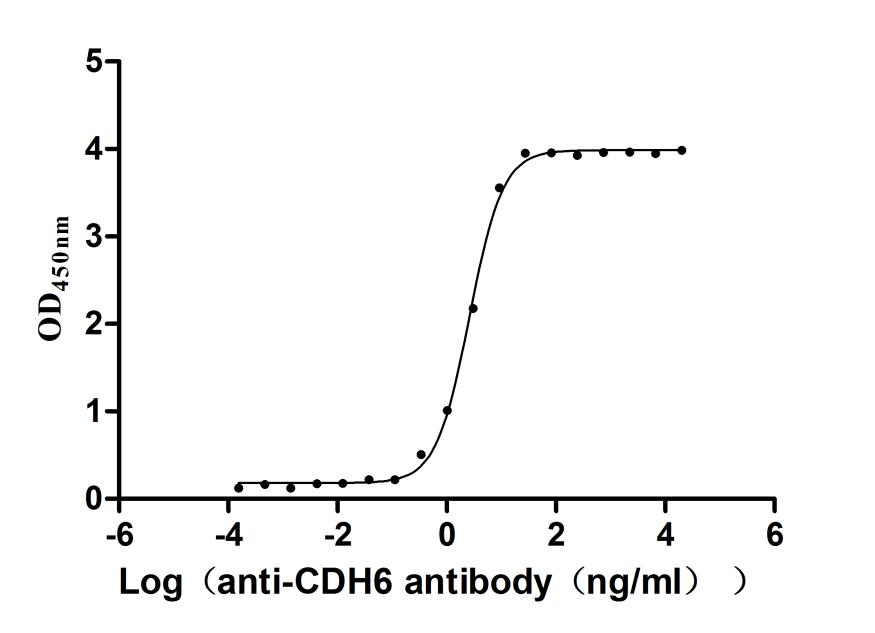
Recombinant Human Cadherin-6 (CDH6), partial (Active)
Express system: Mammalian cell
Species: Homo sapiens (Human)
-
-AC1.jpg)
Recombinant Human Tumor necrosis factor ligand superfamily member 15(TNFSF15) (Active)
Express system: Mammalian cell
Species: Homo sapiens (Human)