Recombinant Human Chemokine-like receptor 1 (CMKLR1), partial
In Stock-
品名簡稱:Recombinant Human CMKLR1 protein, partial
-
貨號:CSB-EP005614HU1
-
說明書:
-
規格:¥1836
-
圖片:
-
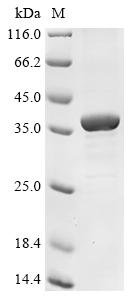 (Tris-Glycine gel) Discontinuous SDS-PAGE (reduced) with 5% enrichment gel and 15% separation gel.
-
-
其他:
產品詳情
-
純度:Greater than 85% as determined by SDS-PAGE.
-
基因名:
-
Uniprot No.:
-
種屬:Homo sapiens (Human)
-
蛋白長度:Partial
-
來源:E.coli
-
分子量:41.3 kDa
-
表達區域:321-373aa
-
氨基酸序列QDFKKFKVALFSRLVNALSEDTGHSSYPSHRSFTKMSSMNERTSMNERETGML
Note: The complete sequence may include tag sequence, target protein sequence, linker sequence and extra sequence that is translated with the protein sequence for the purpose(s) of secretion, stability, solubility, etc.
If the exact amino acid sequence of this recombinant protein is critical to your application, please explicitly request the full and complete sequence of this protein before ordering. -
蛋白標簽:N-terminal 10xHis-GST-tagged and C-terminal Myc-tagged
-
產品提供形式:Liquid or Lyophilized powder
Note: We will preferentially ship the format that we have in stock, however, if you have any special requirement for the format, please remark your requirement when placing the order, we will prepare according to your demand. -
緩沖液:If the delivery form is liquid, the default storage buffer is Tris/PBS-based buffer, 5%-50% glycerol. If the delivery form is lyophilized powder, the buffer before lyophilization is Tris/PBS-based buffer, 6% Trehalose.
-
復溶:We recommend that this vial be briefly centrifuged prior to opening to bring the contents to the bottom. Please reconstitute protein in deionized sterile water to a concentration of 0.1-1.0 mg/mL.We recommend to add 5-50% of glycerol (final concentration) and aliquot for long-term storage at -20°C/-80°C. Our default final concentration of glycerol is 50%. Customers could use it as reference.
-
儲存條件:Store at -20°C/-80°C upon receipt, aliquoting is necessary for mutiple use. Avoid repeated freeze-thaw cycles.
-
保質期:The shelf life is related to many factors, storage state, buffer ingredients, storage temperature and the stability of the protein itself.
Generally, the shelf life of liquid form is 6 months at -20°C/-80°C. The shelf life of lyophilized form is 12 months at -20°C/-80°C. -
貨期:3-7 business days
-
注意事項:Repeated freezing and thawing is not recommended. Store working aliquots at 4°C for up to one week.
-
Datasheet & COA:Please contact us to get it.
產品評價

相關產品
靶點詳情
-
功能:Receptor for the chemoattractant adipokine chemerin/RARRES2 and for the omega-3 fatty acid derived molecule resolvin E1. Interaction with RARRES2 initiates activation of G proteins G(i)/G(o) and beta-arrestin pathways inducing cellular responses via second messenger pathways such as intracellular calcium mobilization, phosphorylation of MAP kinases MAPK1/MAPK3 (ERK1/2), TYRO3, MAPK14/P38MAPK and PI3K leading to multifunctional effects, like, reduction of immune responses, enhancing of adipogenesis and angionesis PubMed:27716822. Resolvin E1 down-regulates cytokine production in macrophages by reducing the activation of MAPK1/3 (ERK1/2) and NF-kappa-B. Positively regulates adipogenesis and adipocyte metabolism.; (Microbial infection) Acts as a coreceptor for several SIV strains (SIVMAC316, SIVMAC239, SIVMACL7E-FR and SIVSM62A), as well as a primary HIV-1 strain (92UG024-2).
-
基因功能參考文獻:
- levels in cord blood, peripheral blood, adipose tissue and placenta tissue significantly higher in gestational diabetes PMID: 29430984
- CMKLR1 and GPR1 were widely expressed in vascular smooth muscle. PMID: 27742615
- Both ALX and ChemR23 were present in human synovium and medial tibial plateau bone obtained following total knee replacement surgery for osteoarthritis. PMID: 27860453
- Results show that ChemR23 is highly expressed in squamous oesophageal cancer tumors and cell lines. PMID: 27092781
- CMKLR1 exacerbated the proliferation and migration of VSMCs by activating ERK1/2. PMID: 27792688
- We demonstrated that chemerin is linked to metabolic syndrome components. Moreover, serum chemerin levels were associated significantly with obesity, especially visceral adipose tissue, in subjects with T2DM [type 2 diabetes mellitus]. PMID: 28120562
- Study shows that hepatic CMKLR1 mRNA is weakly associated with features of NASH in male patients only. PMID: 27548138
- Our results show that higher levels of circulating chemerin, CRP, fibrinogen, and ESR are associated with an increased risk of developing colorectal cancer PMID: 26628300
- Data show inverse Relationship of the CMKLR1 Relative Expression and Chemerin Serum Levels in Obesity with Dysmetabolic Phenotype and Insulin Resistance PMID: 27239101
- Results indicate that Abeta42 activates CMKLR1, leading to glia cell migration and clearance of Abeta42; and is involved in Abeta processing and clearance PMID: 25079809
- Gestational obesity and gestational diabetes mellitus may contribute to elevated serum chemerin. Serum chemerin in pregnancy was associated with insulin resistance and triglycerides. Chemerin gene may play a role both in obese and gestational diabetes mellitus patients PMID: 25627894
- Increased chemerin expression in dermal blood vessels may be associated with the development of digital ulcers in systemic sclerosis. PMID: 25539827
- The study for the first time confirmed a marked expression of chemerin and CMKLR1 in the liver of chronic hepatitis patients. PMID: 25121101
- ChemR23, the receptor for chemerin and resolvin E1, is expressed and functional on M1 but not on M2 macrophages. PMID: 25637017
- The effects of diclofenac on the incidence of pancreatitis following endoscopic retrograde cholangiopancreatography via lipoxin A4 and resolvin D1 and E1 levels is reported. PMID: 25030943
- Results lend some support to a presumable role of locally produced chemerin in the progression of atherosclerotic lesions, possibly acting through its CMKLR1 receptor. PMID: 24779513
- This study identified the up-regulation of ChemR23 in post-traumatic injury of calcaneal articular fracture PMID: 24689495
- ChemR23 is expressed in neutrophil granules and rapidly upregulated upon neutrophil activation. PMID: 23999103
- Development of a membrane-anchored chemerin receptor agonist as a novel modulator of allergic airway inflammation and neuropathic pain. PMID: 24659779
- Chemerin receptor showed increased expression in the lymph nodes and the spleen. PMID: 23904282
- Prochemerin processing protease converts prochemerin into active chemerinF; the activating truncation by the protease may trigger a structural C-terminal rearrangement leading to increased affinity of chemerin to chemokine-like receptor (CMKLR)1. PMID: 23495698
- review of current research on biological roles of chemerin and chemokine-like receptor 1; highlight roles in mediating obesity and development of type 2 diabetes [REVIEW] PMID: 22610747
- The interaction of chemerin and ChemR23 may play an important role in the pathogenesis of rheumatoid arthritis through the resultant activation of fibroblast-like synoviocytes. PMID: 21959042
- These results rule out the direct anti-inflammatory effect of chemerin on macrophages ex vivo, described previously in the literature, despite the expression of a functional ChemR23 receptor in these cells. PMID: 22768214
- Chemerin, a ligand for the G-protein coupled receptor chemokine-like receptor 1, requires carboxy-terminal proteolytic processing to unleash its chemoattractant activity PMID: 21715684
- The ChemR23/Chemerin axis may have a role in the recruitment of dendritic cells within the kidney in patients affected by lupus nephritis. PMID: 21346723
- A genetic variation in the chemokine-like receptor 1 (CMKLR1) gene was statistically significantly associated with decreased overall survival in the three individual populations as well as in pooled analyses. PMID: 21483023
- These results demonstrate that human chondrocytes express both the receptor ChemR23 and the ligand chemerin...which may play pivotal roles in joint inflammation. PMID: 21192818
- the presence of ChemR23 in human endothelial cells, its significant up-regulation by pro-inflammatory cytokines, and its role in angiogenesis were demonstrated. PMID: 20044979
- RvE1 initiates direct activation of ChemR23 and signals receptor-dependent phosphorylation PMID: 19906641
- ChemR23 mediates the Resolvin E1 signal to attenuate nuclear factor-kappaB PMID: 15753205
- The results strongly support that the chemerin receptor, in the presence of CD4, functions as a "minor co-receptor" promoting infection by HIV-1, HIV-2 and SIV. PMID: 16904155
- CMKLR1 is expressed by circulating pDC in normal individuals and patients suffering from skin diseases, such as psoriasis and atopic dermatitis. PMID: 19168032
顯示更多
收起更多
-
亞細胞定位:Cell membrane; Multi-pass membrane protein.
-
蛋白家族:G-protein coupled receptor 1 family
-
組織特異性:Prominently expressed in developing osseous and cartilaginous tissue. Also found in adult parathyroid glands. Expressed in cardiovascular system, brain, kidney, gastrointestinal tissues and myeloid tissues. Expressed in a broad array of tissues associated
-
數據庫鏈接:
Most popular with customers
-
Recombinant Human CD276 antigen (CD276), partial (Active)
Express system: Mammalian cell
Species: Homo sapiens (Human)
-
Recombinant Human Angiotensin-converting enzyme 2 (ACE2), partial (Active)
Express system: Mammalian cell
Species: Homo sapiens (Human)
-
Recombinant Human Retinol-binding protein 4 (RBP4) (Active)
Express system: Mammalian cell
Species: Homo sapiens (Human)
-
Recombinant Mouse Semaphorin-4D (Sema4d), partial (Active)
Express system: Mammalian cell
Species: Mus musculus (Mouse)
-
Recombinant Human E3 ubiquitin-protein ligase ZNRF3 (ZNRF3), partial (Active)
Express system: Mammalian cell
Species: Homo sapiens (Human)
-
Recombinant Rat Microtubule-associated protein tau (Mapt) (Active)
Express system: Mammalian cell
Species: Rattus norvegicus (Rat)
-
-AC5.jpg)
Recombinant Human Claudin-6 (CLDN6)-VLPs (Active)
Express system: Mammalian cell
Species: Homo sapiens (Human)
-
Recombinant Human Claudin-4 (CLDN4)-VLPs (Active)
Express system: Mammalian cell
Species: Homo sapiens (Human)