UQCRFS1 Recombinant Monoclonal Antibody
-
中文名稱:UQCRFS1 Recombinant Monoclonal Antibody
-
貨號:CSB-RA226315A0HU
-
規格:¥1320
-
圖片:
-
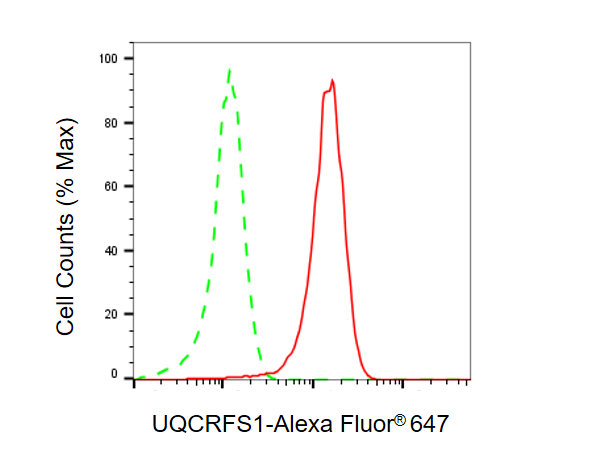 Flow cytometric analysis of UQCRFS1 expression in HepG2 cells using UQCRFS1 antibody. Green, isotype control; red, UQCRFS1.
 -
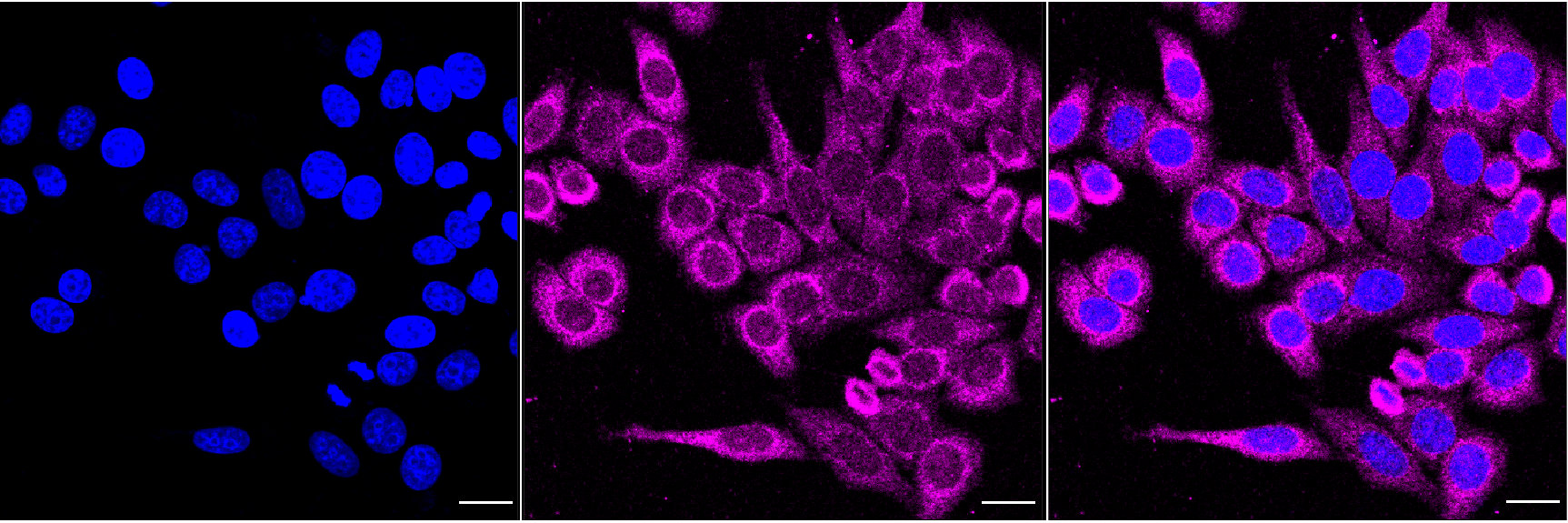 Immunocytochemical staining of HepG2 cells with UQCRFS1 antibody. Nuclei were stained blue with DAPI; UQCRFS1 was stained magenta with Alexa Fluor? 647. Images were taken using Leica stellaris 5. Protein abundance based on laser Intensity and smart gain: Medium. Scale bar, 20 μm.
 -
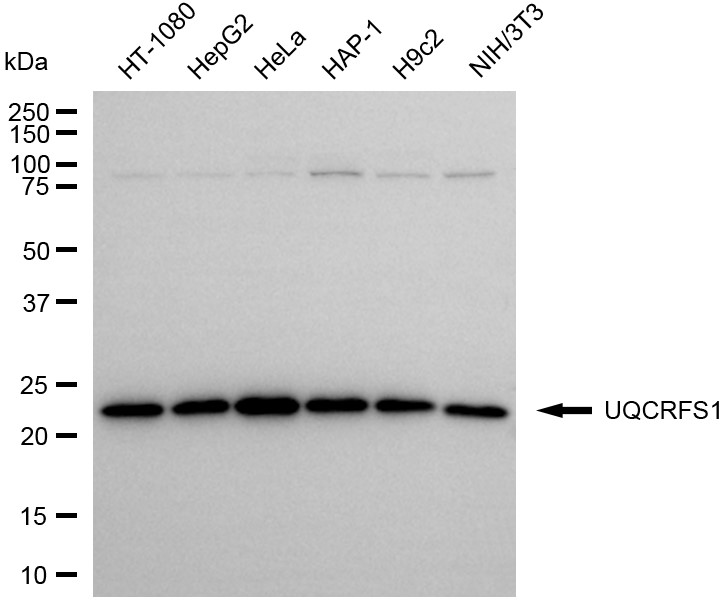 Western blotting analysis using UQCRFS1 antibody. Total cell lysates (30 μg) from various cell lines were loaded and separated by SDS-PAGE. The blot was incubated with UQCRFS1 antibody and HRP-conjugated goat anti-rabbit secondary antibody respectively.
-
-
其他:
產品詳情
-
Uniprot No.:
-
基因名:
-
別名:UQCRFS1; Ubiquinol-Cytochrome C Reductase, Rieske Iron-Sulfur Polypeptide 1; RISP; Cytochrome B-C1 Complex Subunit 5; UQCR5; RIS1; RIP1; Cytochrome B-C1 Complex Subunit Rieske, Mitochondrial; Ubiquinol-Cytochrome C Reductase Iron-Sulfur Subunit; Rieske Iron-Sulfur Protein; Rieske Protein UQCRFS1; Complex III Subunit 5; Epididymis Secretory Sperm Binding Protein; EC 1.10.2.2; EC 7.1.1.8; MC3DN10
-
反應種屬:Human, Mouse, Rat
-
免疫原:Recombinant Human UQCRFS1 protein
-
免疫原種屬:Homo sapiens (Human)
-
標記方式:Non-conjugated
-
克隆類型:Monoclonal
-
抗體亞型:Rabbit IgG
-
純化方式:Affinity-chromatography
-
克隆號:2E6
-
濃度:It differs from different batches. Please contact us to confirm it.
-
保存緩沖液:Rabbit IgG in PBS (pH 7.4) containing 50% glycerol, and 0.02% sodium azide.
-
產品提供形式:Liquid
-
應用范圍:ELISA, WB, FC, ICC
-
推薦稀釋比:
Application Recommended Dilution WB 1:1000-1:5000 FC 1:200-1:2000 ICC 1:100-1:1000 -
Protocols:
-
儲存條件:Upon receipt, store at -20°C or -80°C. Avoid repeated freeze.
-
貨期:Basically, we can dispatch the products out in 1-3 working days after receiving your orders. Delivery time maybe differs from different purchasing way or location, please kindly consult your local distributors for specific delivery time.
-
用途:For Research Use Only. Not for use in diagnostic or therapeutic procedures.
產品評價

相關產品
靶點詳情
-
功能:Component of the ubiquinol-cytochrome c oxidoreductase, a multisubunit transmembrane complex that is part of the mitochondrial electron transport chain which drives oxidative phosphorylation. The respiratory chain contains 3 multisubunit complexes succinate dehydrogenase (complex II, CII), ubiquinol-cytochrome c oxidoreductase (cytochrome b-c1 complex, complex III, CIII) and cytochrome c oxidase (complex IV, CIV), that cooperate to transfer electrons derived from NADH and succinate to molecular oxygen, creating an electrochemical gradient over the inner membrane that drives transmembrane transport and the ATP synthase. The cytochrome b-c1 complex catalyzes electron transfer from ubiquinol to cytochrome c, linking this redox reaction to translocation of protons across the mitochondrial inner membrane, with protons being carried across the membrane as hydrogens on the quinol. In the process called Q cycle, 2 protons are consumed from the matrix, 4 protons are released into the intermembrane space and 2 electrons are passed to cytochrome c. The Rieske protein is a catalytic core subunit containing a Component of the ubiquinol-cytochrome c oxidoreductase (cytochrome b-c1 complex, complex III, CIII). UQCRFS1 undergoes proteolytic processing once it is incorporated in the complex III dimer. One of the fragments, called subunit 9, corresponds to its mitochondrial targeting sequence (MTS). The proteolytic processing is necessary for the correct insertion of UQCRFS1 in the complex III dimer, but the persistence of UQCRFS1-derived fragments may prevent newly imported UQCRFS1 to be processed and assembled into complex III and is detrimental for the complex III structure and function.
-
基因功能參考文獻:
- UQCRFS1 produces N-terminal polypeptides, which remain bound to holocomplex III. We show that, in normal conditions, these UQCRFS1 fragments are rapidly removed, but when TTC19 is absent they accumulate within complex III, causing its structural and functional impairment. PMID: 28673544
- UQCRFS1/RISP knockdown in breast tumor cell line led to decreased mitochondrial membrane potential as well as a decrease in matrigel invasion. PMID: 21901141
- UQCRFS1 gene appears to be involved in development of more aggressive phenotype of breast cancer. PMID: 15047214
-
亞細胞定位:Mitochondrion inner membrane; Single-pass membrane protein.
-
數據庫鏈接:
Most popular with customers
-
-
YWHAB Recombinant Monoclonal Antibody
Applications: ELISA, WB, IHC, IF, FC
Species Reactivity: Human, Mouse, Rat
-
Phospho-YAP1 (S127) Recombinant Monoclonal Antibody
Applications: ELISA, WB, IHC
Species Reactivity: Human
-
-
-
-
-