FOXE3 Antibody
-
中文名稱(chēng):FOXE3兔多克隆抗體
-
貨號(hào):CSB-PA618775LA01HU
-
規(guī)格:¥440
-
圖片:
-
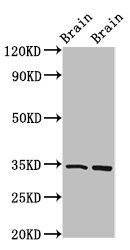 Western Blot
Positive WB detected in: Mouse brain tissue, Rat brain tissue
All lanes: FOXE3 antibody at 4μg/ml
Secondary
Goat polyclonal to rabbit IgG at 1/50000 dilution
Predicted band size: 34 kDa
Observed band size: 34 kDa -
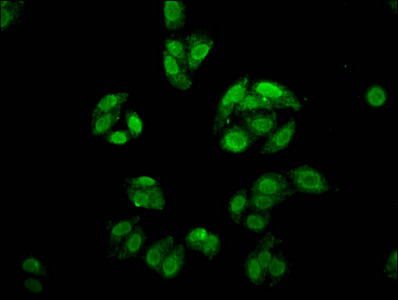 Immunofluorescence staining of HepG2 cells with CSB-PA618775LA01HU at 1:166, counter-stained with DAPI. The cells were fixed in 4% formaldehyde, permeabilized using 0.2% Triton X-100 and blocked in 10% normal Goat Serum. The cells were then incubated with the antibody overnight at 4°C. The secondary antibody was Alexa Fluor 488-congugated AffiniPure Goat Anti-Rabbit IgG(H+L).
-
-
其他:
產(chǎn)品詳情
-
產(chǎn)品名稱(chēng):Rabbit anti-Homo sapiens (Human) FOXE3 Polyclonal antibody
-
Uniprot No.:
-
基因名:FOXE3
-
別名:Drosphilia Forkhead Homolog Like 12 antibody; FKHL 12 antibody; FKHL12 antibody; Forkhead Box E3 antibody; Forkhead box protein E3 antibody; Forkhead Related Activator 8 antibody; Forkhead related protein FKHL12 antibody; Forkhead-related protein FKHL12 antibody; Forkhead-related transcription factor 8 antibody; Foxe3 antibody; FOXE3 forkhead box E3 antibody; FOXE3_HUMAN antibody; FREAC 8 antibody; FREAC-8 antibody; FREAC8 antibody
-
宿主:Rabbit
-
反應(yīng)種屬:Human, Rat, Mouse
-
免疫原:Recombinant Human Forkhead box protein E3 protein (4-74AA)
-
免疫原種屬:Homo sapiens (Human)
-
標(biāo)記方式:Non-conjugated
本頁(yè)面中的產(chǎn)品,F(xiàn)OXE3 Antibody (CSB-PA618775LA01HU),的標(biāo)記方式是Non-conjugated。對(duì)于FOXE3 Antibody,我們還提供其他標(biāo)記。見(jiàn)下表:
-
克隆類(lèi)型:Polyclonal
-
抗體亞型:IgG
-
純化方式:>95%, Protein G purified
-
濃度:It differs from different batches. Please contact us to confirm it.
-
保存緩沖液:Preservative: 0.03% Proclin 300
Constituents: 50% Glycerol, 0.01M PBS, pH 7.4 -
產(chǎn)品提供形式:Liquid
-
應(yīng)用范圍:ELISA, WB, IF
-
推薦稀釋比:
Application Recommended Dilution WB 1:500-1:5000 IF 1:50-1:200 -
Protocols:
-
儲(chǔ)存條件:Upon receipt, store at -20°C or -80°C. Avoid repeated freeze.
-
貨期:Basically, we can dispatch the products out in 1-3 working days after receiving your orders. Delivery time maybe differs from different purchasing way or location, please kindly consult your local distributors for specific delivery time.
-
用途:For Research Use Only. Not for use in diagnostic or therapeutic procedures.
產(chǎn)品評(píng)價(jià)

相關(guān)產(chǎn)品
靶點(diǎn)詳情
-
功能:Transcription factor that controls lens epithelial cell growth through regulation of proliferation, apoptosis and cell cycle. During lens development, controls the ratio of the lens fiber cells to the cells of the anterior lens epithelium by regulating the rate of proliferation and differentiation. Controls lens vesicle closure and subsequent separation of the lens vesicle from ectoderm. Controls the expression of DNAJB1 in a pathway that is crucial for the development of the anterior segment of the eye.
-
基因功能參考文獻(xiàn):
- The sclerocornea-microphthalmia-aphakia complex is a severe malformative ocular phenotype resulting from mutations in the FOXE3 transcription factor. To date, patients from at least 14 families with this uncommon ocular disorder have been described. The identification of 2 novel pathogenic variants in our patients expands the mutational spectrum in FOXE3-related congenital eye disorders. PMID: 29878917
- Data show that DnaJ (Hsp40) homolog, subfamily B, member 1 (DNAJB1) is a transcriptional target of forkhead box protein E3 (FOXE3) in a pathway that is crucial for the development of the anterior segment of the eye. PMID: 27218149
- Although congenital aphakia is known to be caused by mutations in the FOXE3 gene, the results of lack of coding mutation in this patient suggests a possible genetic heterogeneity of the disease. PMID: 28805541
- Only one novel missense mutation in exon 1 of FOXE3 (Chr1:47,882,459, c.472G>C, p.Gly158Arg) was identified being homozygous in the three affected and heterozygous in the two unaffected, which was confirmed by Sanger sequencing. PMID: 27669367
- FOXE3 mutations lead to a reduced number of aortic smooth muscle cells (SMCs) during development and increased SMC apoptosis in the ascending aorta in response to increased biomechanical forces. PMID: 26854927
- This is the first functional evidence demonstrating that FOXE3 mutations identified in patients impair protein function with differential effects. PMID: 25504734
- Our results indicate that the FOXE3 p.Val201Met allele is associated with eye defects (OR = 3.5), suggesting its involvement as an ocular malformation risk factor. PMID: 24689660
- This study demonstrates that a cluster of patients with sclerocornea, aphakia, and microphthalmia in a small Mexican village is due to a FOXE3 p.Y98H founder mutation. PMID: 24019743
- shRNA-mediated gene silencing of FOXE3 could significantly inhibit cell growth and induce the G1-phase arrest in human lens epithelial cell line-3 cells. PMID: 22527307
- The FOXE3 mutation detected in c.601 G > A, predicting p.Val201Met which were not yet been included in public databases, but has previously been reported in both A/M patients. PMID: 22204637
- Autosomal-dominant mutations within FOXE3 cause anterior segment dysgenesis and has important clinical utility, especially for the diagnosis of mildly affected patients. PMID: 21150893
- Using autoantibodies from systemic sclerosis (SSc) patients, two anti-CENP-A-specific motifs were defined in its immunodominant epitope Ap17-30. One of these motifs matched residues 53-62 of FOXE3, a protein not previously implicated in SSc. PMID: 20630806
- This is the fourth report detailing homozygous FOXE3 mutations causing anterior segment abnormalities in human patients. PMID: 20664696
- Mutations in several transcription factors associated with aniridia and congenital cataract, FOXE3, (PAX6), PITX2, and PITX3 genes, were examined. PMID: 20806047
- FOXE3 is responsible for the early developmental arrest of the lens placode, and the complete loss of a functional FOXE3 protein results in primary aphakia. PMID: 20361012
- Recessive mutations in FOXE3 were found in four of 26 probands affected with bilateral microphthalmia (15% of all bilateral microphthalmia and 100% of consanguineous families with this phenotype). PMID: 20140963
- Role very early in the lens developmental program, perhaps earlier than any role recognized elsewhere for this gene. PMID: 16826526
- findings suggest that mutations in FOXE3 can give rise to a broad spectrum of eye anomalies, largely, but not exclusively related to lens development, and that both dominant and recessive inheritance patterns can be represented PMID: 19708017
- FOXE3 is essential for closure of the lens vesicle during eye development and for lens epithelial survival and proliferation. PMID: 10652278
顯示更多
收起更多
-
相關(guān)疾病:Anterior segment dysgenesis 2 (ASGD2); Cataract 34, multiple types (CTRCT34); Aortic aneurysm, familial thoracic 11 (AAT11)
-
亞細(xì)胞定位:Nucleus.
-
數(shù)據(jù)庫(kù)鏈接:
Most popular with customers
-
-
Phospho-YAP1 (S127) Recombinant Monoclonal Antibody
Applications: ELISA, WB, IHC
Species Reactivity: Human
-
-
-
-
-
-